On this page
Almost everything written about AI voice agents stops at the demo. The agent answers, it sounds convincing, the video ends. What the video never shows is the part that decides whether the thing is worth paying for: what happened to the caller's details afterwards, whether a real slot was held in a real calendar, and what the agent did with the question it could not answer.
This article walks a single inbound call end to end — eight steps, from the ring to the record in your CRM — and names the failure mode at each one. If you have not yet decided whether a voice agent makes sense for your business at all, start with the complete guide to AI voice agents for small business and come back here when you are evaluating a specific build.
The short version
A voice agent is only as good as the four things it does after it stops talking: writing the booking, writing the record, sending the confirmation, and knowing when to hand over. Evaluate a provider on those four, not on how natural the voice sounds.
Why the call flow is the thing to evaluate
There is a gap opening between businesses that have adopted AI and businesses that have implemented it. In the Goldman Sachs 10,000 Small Businesses survey fielded in early 2026 — 1,256 participants, run with Babson College and David Binder Research — 76% of small businesses reported using AI, but only 14% had fully integrated it into their core operations.
That distance between 76% and 14% is the whole story. Adoption is easy; integration is the work. Microsoft's 2026 Work Trend Index, which surveyed 20,000 knowledge workers across ten countries between February and April 2026, puts the same finding in a different frame: organisational factors account for more than twice the reported AI impact of individual factors. How the thing is wired into the business matters more than the fact that you bought one.
For a voice agent, the wiring is the call flow. Two agents can use the same speech models and the same voice and produce completely different results, because one of them writes to your calendar and your CRM and one of them emails you a transcript you will read on Monday.
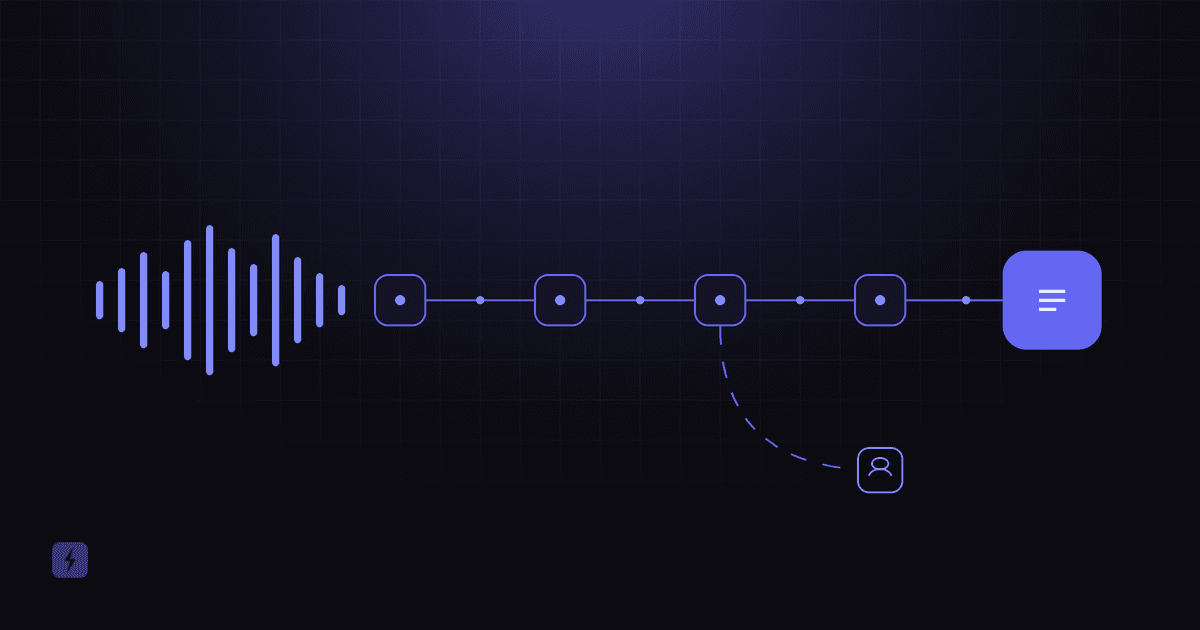
The eight steps of a Flasin voice agent call
What follows is a reference build — the shape we use as a starting point for an inbound line, not a case study of a specific client. Every business changes at least two of these steps. It is here so you have something concrete to compare a proposal against.
1. The call arrives
Nothing about your existing phone setup has to be thrown away. In most builds the agent sits behind conditional forwarding on the number you already advertise: it picks up only when nobody answers within a set number of rings, or only outside your opening hours. Your team keeps the calls it wants and the agent catches the rest.
Where this breaks: forwarding rules that were configured once and never tested against a real weekend. Before go-live, call your own number at 8pm on a Saturday from a phone that is not on your account. It is the cheapest test in this entire article and it catches the most expensive failure.
2. The agent answers and says what it is
The greeting carries your business name and your tone, and it should make clear within the first sentence that the caller is speaking to an automated assistant. This is partly a legal question — disclosure rules for AI callers vary by jurisdiction and several have tightened — and partly a practical one. Callers who are told up front tend to speak in shorter, clearer sentences, which measurably improves how well the rest of the call goes. Callers who work it out for themselves halfway through tend to feel misled.
Where this breaks: a greeting written to disguise the agent. It buys nothing and costs trust the first time it fails.
3. It identifies intent
This is the step that separates a voice agent from the old "press 1 for sales" tree. The caller describes their problem in their own words and the agent maps it to one of a deliberately small set of intents — book, reschedule, cancel, quote, existing job, general question, urgent — plus an explicit none of these, which is the most important entry in the list.
Keep the set small. Every intent you add is another branch that has to be written, tested and maintained, and the long tail of rare requests is exactly the traffic a human handles better anyway.
Where this breaks: an agent with no none of these branch will force an ambiguous call into the nearest intent it recognises, and the caller ends up booking a service they did not ask for.
4. It qualifies the lead
Qualification is just asking the three or four questions your team would ask anyway, and — the part that matters — writing the answers into named fields rather than leaving them in a transcript. "They mentioned they are in Croydon and it is fairly urgent" is a sentence. location: Croydon, urgency: within_48h is data you can route, filter and report on.
Three or four questions is the ceiling. Every extra question loses callers, and a voice agent is not a form — the caller cannot see how many are left, which makes an over-long qualification sequence feel considerably worse on the phone than it does on a web page.
Where this breaks: qualification designed to protect your team's time rather than to serve the caller. If the first thing a new customer is asked is their budget, a proportion of them will hang up, and they will be the ones with options.
5. It books the appointment
The agent reads live availability, offers two or three genuine options rather than asking the open-ended "when suits you", and writes the booking. Offering specific slots is both faster and better: an open question makes the caller do the work and produces times you cannot honour.
The technical detail that matters here is the hold. Between the moment a slot is offered and the moment the caller says yes, that slot has to be locked, or two agents — or an agent and a human at the front desk — will sell the same 2pm on Thursday. The mechanics of this, including buffers, travel time and no-show handling, are covered in AI appointment booking.
Where this breaks: an agent writing to a calendar it can read but cannot lock. Ask any provider directly how they prevent double-booking. A vague answer is your answer.
6. It updates the CRM
This is the step most demos skip and most buyers forget to ask about, and it is where a voice agent stops being a novelty. After the call, the agent should create or match a contact, open a deal or job record against it, attach the transcript and a short summary, and set the source so you can tell later which channel produced the work.
Three things have to be decided before any of that can be built, and they are business decisions rather than technical ones:
- Matching. When someone calls from a number you already hold, is that the same person? Phone number is the usual key, but shared household and office lines break it. Decide what happens on an ambiguous match — usually: create the record, flag it for review, never silently merge.
- Field mapping. Every qualification field needs a home in your CRM, and CRMs are opinionated about their own fields. This is where most of the integration effort actually goes, and it is worth doing properly once.
- Failure handling. Your CRM will be unreachable at some point. The agent must queue the write and retry rather than dropping it, because a lead that exists only in a failed API call is a lead you never had.
Most modern CRMs — HubSpot, Pipedrive, Zoho, Salesforce, GoHighLevel, Monday — expose this over a straightforward API, and anything with a webhook can be reached one way or another. If yours is older or in-house, the connection is still usually possible; it just moves from configuration into development work, which is a schedule and cost question worth raising in the first conversation, not the fifth. Our AI automation service covers this integration layer specifically.
Where this breaks: silent write failures. If nobody is alerted when the CRM write fails, you will find out weeks later, from a customer.
7. It sends the confirmation
The confirmation should fire from the booking record, not from the end of the call, and it should arrive within seconds — while the caller is still holding their phone. It carries the time, the address or the joining link, what to bring, and a reschedule link. That last item is not a courtesy: a caller who can reschedule in one tap reschedules, and a caller who has to phone you back during business hours becomes a no-show.
Where this breaks: confirmations sent on a schedule rather than on the event. If the booking fails but the confirmation goes out anyway, someone arrives to an appointment that does not exist.
8. It escalates what it should not handle
The eighth step is not the exception path. It is a first-class outcome, and on a well-built line a meaningful share of calls should end here by design. A warm transfer during opening hours, or a task raised with the transcript attached, an owner named and a callback time the caller was actually told.
Where this breaks: "I'll get someone to call you back" with no task, no owner and no time. That is not an escalation; it is a voicemail with better manners.
Where a human should take over
Designing the handover is not a concession you make to the technology's limits. It is what makes callers willing to use it at all. In Salesforce's seventh-edition State of the AI Connected Customer research — 15,015 consumers, surveyed by YouGov across 18 countries in July and August 2024 — 45% said they are more likely to use an AI agent if there is a clear escalation path. The exit is part of the product.
Five situations should route to a person, and they should be written into the configuration before the agent takes its first call:
The caller asks for a human
Immediately, on the first ask, with no retention attempt. An agent that argues about this is the single fastest way to turn a routine call into a complaint.
Anything urgent or safety-related
Medical, structural, safeguarding, a vulnerable caller, anything with the word emergency in it. These get a defined path — usually a direct transfer or a specific instruction — and the agent should never attempt to triage them itself.
Anger, distress or confusion
Detectable, and the correct response is always the same: stop, hand over, do not try to resolve it. A frustrated caller who has to explain themselves a second time to a machine is a review you will be reading later.
Money outside a defined band
Refunds, discounts, disputes, quotes above a threshold you set. Give the agent an explicit ceiling and route everything above it. The ceiling is a business decision, not a technical one.
The third failed attempt at the same thing
If the agent has not understood something twice, it will not understand it on the third try. Count the loops and break out. Nearly every bad voice AI story on the internet is an agent that would not stop trying.
86% of AI users say they treat AI output as a starting point, not a final answer, and that they stay responsible for the thinking.
The same instinct applies to a phone line. The agent produces a first pass — a captured lead, a proposed booking, a summarised problem — and a person stays responsible for the judgement calls. Build it that way and the technology holds up. Build it as a wall between you and your customers and it will not.
How to work out the ROI
There is no honest industry benchmark for what a voice agent returns, because the answer depends almost entirely on two things nobody else knows: how many calls you currently miss, and what a job is worth to you. Anyone quoting you a return before asking those two questions is quoting you someone else's business.
Here is the arithmetic you can run yourself, before you buy anything. It takes about twenty minutes with your phone bill and your accounts.
Recovered gross profit per month is A × B × C × D × E. With the arbitrary placeholder figures above, that is 120 × 0.40 × 0.60 × 0.25 × £300 = £2,160 per month of gross profit that currently goes to whoever the caller rang next. Compare that against F to get your break-even. These numbers are illustrative only — they are placeholders chosen to show the shape of the calculation, and your own five inputs will produce a different answer. For how the cost side is usually structured, see how much an AI voice agent costs.
The three numbers people get wrong
- Using revenue instead of gross profit for E. A £3,000 job with £2,700 of materials and labour in it is not a £3,000 win. Using revenue can overstate the return by an order of magnitude and it is the most common error in every voice AI ROI deck on the internet.
- Assuming every missed call is a lost customer. It is not. That is what B exists to correct, and the only way to know your B is to listen to thirty of your own missed calls. Most businesses are surprised in both directions.
- Forgetting month one. Setup, configuration and the first weeks of reviewing transcripts and correcting the agent are real costs, in money and in somebody's attention. Amortise them into F rather than pretending the system arrives finished.
Measure C, do not estimate it
The share of callers an agent successfully captures is the input with the widest range and the one most often guessed. Run the agent for 30 days, count the outcomes in your CRM, and recalculate. If a provider will not let you measure this, that is information too.
What this does not replace
A voice agent handles the repetitive, structured, high-volume part of a phone line: the same twelve questions, the bookings, the after-hours calls that currently reach voicemail. It does not handle judgement, relationship, negotiation, or the call where something has gone wrong and a customer needs to hear a person take responsibility.
That distinction is not a limitation to be engineered away in the next model release. It is how the businesses getting value out of this are choosing to run it. In the same Goldman Sachs survey, 87% of small businesses said AI augments rather than replaces employees — and that is consistent with what the call flow above actually describes: eight steps, of which the eighth is handing the work to a human with better context than they would otherwise have had.
The businesses that struggle are the ones that bought a voice agent to avoid hiring, and then discovered that the calls it could not handle were the calls that mattered most. The ones that do well treat it as a front desk that never sleeps and never puts anyone on hold, and keep their people for the conversations that need people. If you are weighing that trade-off against a hire, AI voice agents vs traditional call centres works through the comparison properly.
Frequently asked questions
Can an AI voice agent book directly into my calendar?
Yes, provided it can both read live availability and hold a slot while the caller decides. Reading alone is not enough — without a hold, two callers can be offered the same time. Ask any provider specifically how they prevent double-booking.
Can an AI voice agent update my CRM?
For most mainstream CRMs — HubSpot, Pipedrive, Zoho, Salesforce, GoHighLevel, Monday — yes, over their API, and the agent can create or match the contact, open a record, and attach the transcript and summary. Older or in-house systems are usually still reachable, but the work moves from configuration into development, which affects timeline and cost.
Will callers know they are talking to AI?
They should, and the agent should say so in its opening sentence. Disclosure requirements vary by jurisdiction and several have tightened recently. It also works better in practice: callers who are told up front speak more clearly, and callers who work it out mid-call feel misled.
What happens when the agent cannot handle something?
It should transfer to a person during opening hours, or raise a task with the transcript attached, a named owner and a callback time the caller was actually given. A promise of a callback with no task behind it is a voicemail, not an escalation.
How do I know whether it is actually working?
Count outcomes, not calls. The numbers that matter are how many calls were answered that previously were not, how many produced a booking or a qualified lead in your CRM, and how many escalations were resolved. Those are the inputs to the ROI calculation above, and they are all measurable after 30 days.
Does it replace my receptionist?
In our experience the useful framing is coverage rather than replacement: the agent takes the after-hours calls, the overflow when two come in at once, and the repetitive questions, and your receptionist keeps the work that benefits from a person. 87% of small businesses in the Goldman Sachs 2026 survey said AI augments rather than replaces employees.
Where to start
Do the arithmetic first. Pull your missed-call count, listen to thirty of them, and work out what a job is worth to you in gross profit. That single hour tells you more than any demo, and it gives you the questions to ask every provider you talk to: how do you prevent double-booking, how do you write to my CRM, what happens when that write fails, and what exactly makes the agent hand over to a person.
If you would rather have someone walk the flow with you against your own numbers, that is what our AI voice agent work starts with — and the free AI audit is the short version of the same conversation, with no obligation attached.