On this page
Most small businesses asking how to get more customers from their website are already getting enough visitors. The traffic arrives, looks around, and leaves without doing anything — and because nobody was there to see it happen, the natural conclusion is that the site needs more traffic.
It usually does not. Working out how to turn website visitors into customers is a different job from getting them to arrive, and it is generally the cheaper one, because you are working with people who have already shown up.
This guide walks the journey a visitor takes, where they actually drop out of it, which conversion elements close each gap, and how AI chat, booking and follow-up fit in — without pretending any of it guarantees a sale.
The goal, stated precisely
Not more visitors. A clear path that turns the right visitors into conversations, leads, appointments and customers — and lets the wrong ones leave quickly without consuming your team's time.
Why website traffic alone does not create growth
Traffic and conversion multiply. That sounds obvious until you notice which one most businesses spend money on. Doubling your traffic doubles your leads. Doubling your conversion rate also doubles your leads — but it does not double your advertising bill, and it improves the value of every visitor you have already paid for.
An illustrative comparison — not a claim about your site
Take a site with 1,000 monthly visitors converting at 1%: ten leads. Doubling traffic to 2,000 visitors gets you twenty leads and roughly double the acquisition cost. Lifting conversion to 2% also gets you twenty leads, from traffic you were already paying for. The numbers are invented to show the arithmetic — substitute your own.
The second reason traffic alone does not work is more fundamental. A visitor needs four things before they act: to understand what you offer, to get their question answered, to trust you enough, and to see an obvious next step. Miss any one of those and the visit ends, however good the traffic was. More visitors just means more people encountering the same gap.
Which brings up benchmarks, and a warning. Unbounce's Conversion Benchmark Report puts the median landing page conversion rate at 6.6% across all industries, with industry medians ranging from 3.8% to 12.3% — drawn from more than 41,000 landing pages, 464 million visitors and 57 million conversions. Read the fine print, though: that is a vendor dataset of paid-traffic landing pages built by Unbounce customers, not whole websites and not the open web. It is a useful sense of scale and a terrible target. Your own last-quarter number is the only benchmark that means anything.
The journey, and where visitors actually leak out of it
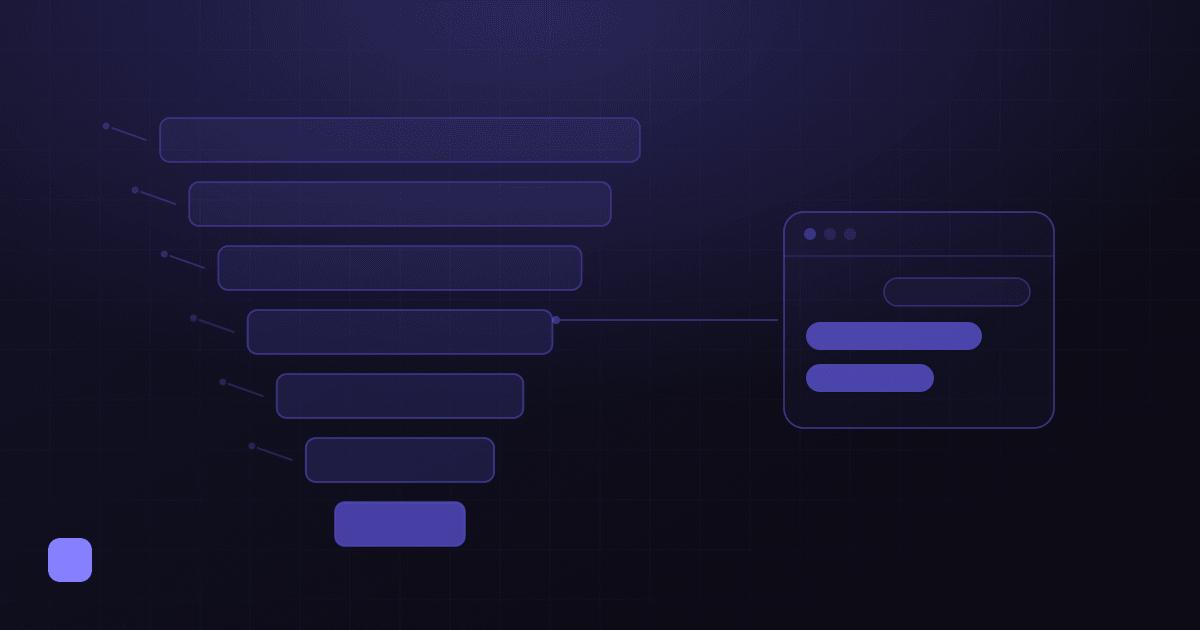
Every conversion path runs through the same stages. Businesses rarely lose everyone at one point — they lose a slice at each, and the compounding is what makes the final number small.
Stage three is the one small businesses most often have no answer for. A visitor with a specific question at 9pm has three options: guess, fill in a form and wait, or check a competitor. Zendesk's CX Trends 2026 research — 11,000+ respondents across 22 countries, fielded June 2025 — found 74% of consumers expect service to be available 24/7. That expectation does not switch off because someone is still deciding whether to buy.
The conversion elements that actually move the number
Landing pages: one job each
A page that tries to speak to everyone converts nobody. The discipline is one audience, one problem, one offer, one next action. Everything else on the page either supports that action or competes with it — and a navigation bar full of alternatives is competition. If you run ads, the page the ad points to should answer the exact promise the ad made, in the same words.
A value proposition a stranger can repeat
Within a few seconds a visitor should be able to say who you help, what problem you solve and why you rather than the last tab they had open. Most small business homepages fail this test by describing the company instead of the customer's problem. Read your own first screen aloud and ask whether it would mean anything to someone who has never heard of you.
CTAs that name the action
"Learn more" and "Get started" ask the visitor to imagine what happens next. Specific CTAs do not: Book a Consultation, Get a Free AI Audit, Talk to an AI Agent, Request a Quote, Check Availability. Each names the thing that happens when you click, which removes the small hesitation that kills a click. Use one primary action per page, repeat it as the reader scrolls, and make it visible without hunting.
Trust signals — real ones only
Testimonials, reviews, case studies, client results, accreditations, guarantees and named clients all reduce the risk a stranger is taking. They only work if they are true. Invented testimonials and fabricated results are both a legal problem and a credibility problem, and prospects are better at spotting them than most businesses assume.
If you do not yet have proof, say something true instead: how long you have operated, how many jobs you have completed, your actual review score with a link to where it lives, or a specific description of your process. A verifiable modest claim outperforms an impressive unverifiable one. Flasin's own case studies follow the same rule — no invented results.
Pricing clarity
Hiding price does not remove the question; it moves it to a form the visitor may not fill in. Full price lists suit productised services and e-commerce. For variable work, a starting-from figure, a typical range, or packages with clear inclusions do most of the job. Where genuinely every job differs, say so and set expectations about the quote itself — what you need to give one, and how quickly it arrives. Flasin publishes its own pricing for exactly this reason.
Appointment booking with fewer steps between
Every step between deciding and scheduling loses people. "Fill in this form and someone will contact you to arrange a time" is three handoffs and at least one delay. Showing real availability and booking it while the visitor is still on the page removes all of them. AI appointment booking covers the mechanics for appointment-driven businesses.
Mobile, and general friction
Most small business traffic is mobile, and most conversion problems are visible on a phone before anywhere else: a form that demands typing on a small keyboard, a CTA below three screens of copy, a date picker that does not work with a thumb, a slow first load. Open your own site on your phone, on mobile data rather than office wifi, and try to become a lead. Whatever irritates you will be losing people.
How AI chatbots turn passive visitors into conversations
The gap between a visitor reading and a visitor acting is usually an unanswered question. A chatbot's real job on a conversion path is not deflection — it is turning a silent browse into a conversation, then into something you can follow up.
- Answering instantly. The specific question — do you cover my area, do you handle this kind of case, what does it start at, how soon could you come — answered at the moment it occurs, not the next working day.
- Identifying intent. Distinguishing someone comparing options from someone ready to book, and responding differently to each.
- Qualifying. Asking your qualifying questions conversationally rather than as a form: budget range, timing, location, service fit.
- Collecting contact details. Gathered naturally once the conversation has value, rather than demanded before it starts.
- Recommending the right service. Pointing a visitor at the offer that matches what they described, instead of leaving them to navigate.
- Booking consultations. Checking real availability and confirming, so interest becomes a diary entry.
- Routing high-value leads. Recognising the enquiry worth interrupting someone for, and notifying the right person immediately.
- Escalating to a person. With the transcript attached. Salesforce's seventh-edition research (15,015 consumers, fielded July–August 2024) found 45% would be more likely to use AI agents where there is a clear path to a person — the exit makes people willing to start.
How AI chatbots generate, qualify and convert website leads is the deep dive on this, including what qualification actually looks like in practice. Two related reads: AI chatbot vs live chat on which conversations belong to software and which to people, and AI chatbots for customer service for the post-sale half.
A chatbot does not create demand
It converts interest that already exists into a conversation. If visitors are leaving because the offer is unclear, the price is wrong or the proof is missing, a chat widget will not fix that — it will just have more conversations that end the same way. Fix the page first, then add the conversation.
Quality also depends entirely on what the bot has been given. A chatbot answering from thin or out-of-date content will confidently repeat whatever is wrong on your site — how to train an AI chatbot on your business covers the content work that decides this.
What happens after the lead is captured
More leads are lost after capture than before it. A lead sitting in an inbox is not a lead; it is a notification somebody may open. The path from captured to booked is a workflow, and it should be an explicit one.
Lead captured
From the chat, the form or the phone — with the context of what they asked, not just a name and an email.
Into the CRM
A real record, immediately, with the conversation attached. If it only exists in an inbox, it will be missed.
Tagged and qualified
Scored against your criteria and labelled by service, source and urgency, so what happens next can differ by lead.
Automated follow-up
A sequence that references what they actually asked about, not a generic template. Timed in hours for hot leads, days for early-stage ones.
Sales team notified
Immediately for anything high value. A qualified lead waiting for someone to check a dashboard is a lead cooling down.
Appointment
The point of the whole path. Everything upstream exists to get a real conversation into a real diary.
Building this is what AI automation consists of in practice, and it is worth scoping deliberately — every step above touches a different system. Zendesk's research also found 74% of consumers are frustrated when they have to repeat information, which applies just as much to a sales handover as to support: pass the conversation along with the contact record.
Reconnecting with visitors who leave — and the consent it needs
Most visitors leave without converting, and retargeting is the standard answer: showing ads to people who visited but did not act, or emailing someone who abandoned a form partway through if they gave you an address and agreed to hear from you.
It comes with rules, and they are not optional. In the UK, the Information Commissioner's Office guidance on storage and access technologies — finalised on 29 April 2026 — requires consent before setting cookies and similar technologies for advertising, analytics or retargeting purposes, with only narrow exemptions such as strictly necessary and communication-related uses. Valid consent must be an explicit opt-in rather than pre-ticked, granular across different purposes, and as easy to withdraw as it was to give.
That is UK guidance specifically; the EU has comparable requirements and US state laws differ considerably, so check what applies where your customers are. The practical consequence is the same everywhere though: your retargeting audience is built from visitors who consented, which is smaller than your total traffic, and building it any other way is a compliance problem rather than a growth tactic.
Partial form data is a judgment call, not a free lead
Capturing what someone typed before abandoning a form is technically easy and reputationally risky. If they did not submit, they did not agree to be contacted. Follow up only where you have a lawful basis and the person would not be surprised to hear from you — a saved quote they asked you to hold is different from an email address they typed and thought better of.
How to measure whether any of it is working
One number tells you almost nothing on its own. Track the whole path, because knowing that conversion is 1.2% is far less useful than knowing that 40% of chats produce a lead and only 8% of leads reach a booking.
- Visitor-to-lead conversion rate — the headline, but only meaningful next to the rest.
- CTA click rate — by page and by position, which tells you whether people are seeing it at all.
- Chatbot engagement rate — the share of visitors who start a conversation.
- Lead capture rate — the share of conversations that produce contact details.
- Qualified lead rate — how many of those leads met your criteria. A rising capture rate with a falling qualified rate is not progress.
- Booking rate — leads that turned into a diary entry.
- Form abandonment — started but not submitted, and which field they stopped at.
- Landing-page conversion, per page, so you know which pages carry the site.
- Lead-to-customer conversion — the number that decides whether any of the above mattered.
- Response time — how long between a lead arriving and a human or automated reply. Split in-hours and out-of-hours.
Resist the temptation to compare yourself to a published "good" conversion rate. Rates vary enormously by industry, traffic source, offer and price point — even the Unbounce dataset spans 3.8% to 12.3% across industries, and it only covers paid-traffic landing pages. Your last quarter is the benchmark. Change one thing, measure, keep or revert.
The mistakes that cost the most
- Buying traffic to fix a conversion problem. More visitors through a leaky path produces more leaks and a bigger bill.
- Asking for everything up front. Every extra required field is a reason to close the tab. Collect the minimum, enrich later.
- Hiding the price entirely. The question does not disappear; it becomes a reason to check a competitor who answered it.
- Making the visitor wait. "Someone will be in touch" is where interest goes to cool, particularly out of hours.
- Capturing leads nobody owns. A lead with no named owner and no follow-up sequence is a lead you paid for and discarded.
- Fabricating proof. Invented testimonials and made-up results are a legal risk and, when spotted, more damaging than having no proof at all.
- Testing five things at once. Change one element, measure it, then move on. Otherwise you learn nothing from an improvement.
- Ignoring mobile. The experience most of your visitors have is the one least often checked properly.
How do I turn more website visitors into customers?
Work the path rather than the traffic. Make each page answer one audience's problem with one clear next action, answer visitors' specific questions immediately, ask for the minimum information needed to follow up, qualify in conversation, let people book a time themselves, and put every lead into a CRM with an owner and a follow-up sequence. Then measure each stage separately so you can see which one is leaking.
What is a good website conversion rate?
There is no universal figure, and treating a published one as a target is misleading. Unbounce's benchmark report puts the median landing page conversion at 6.6% with industry medians from 3.8% to 12.3% — but that dataset covers paid-traffic landing pages built on one platform, not whole websites. Rates vary hugely by industry, traffic source, offer and price. Your own previous quarter is the only benchmark worth optimising against.
Will more traffic get me more customers?
Proportionally, yes — and that is the problem. Doubling traffic roughly doubles leads and roughly doubles your acquisition cost. Improving conversion increases leads from traffic you have already paid for, and it improves the value of every future visitor too. If your conversion path has obvious gaps, fixing those is usually the cheaper move.
Can an AI chatbot increase website conversions?
It can help, and the honest framing matters: a chatbot converts existing interest into a conversation by answering questions instantly, qualifying, capturing details and booking. It does not create demand. If visitors are leaving because your offer is unclear, your pricing is uncompetitive or you have no proof, a chat widget will simply have more conversations that end the same way. Fix the page first.
How many form fields should I ask for?
The fewest that still let you follow up meaningfully — often a name and one contact method. Every additional required field gives someone a reason to stop. Anything else you need can be asked in conversation afterwards, when the person has already invested something and is more willing to answer.
Should I show pricing on my website?
Where you can, yes. Hiding price does not remove the question, it moves it behind a form some visitors will not fill in. Full prices suit productised services; for variable work a starting-from figure, a typical range or packages with clear inclusions usually does the job. Where every job genuinely differs, say so and explain what you need to quote and how fast the quote arrives.
Do I need consent to retarget website visitors?
In the UK, yes for advertising and analytics technologies. The ICO's guidance, finalised in April 2026, requires consent before setting cookies and similar technologies for those purposes, with narrow exemptions, and consent must be an explicit opt-in, granular and easy to withdraw. The EU has comparable requirements and US state laws vary, so check what applies where your customers are. Practically, your retargeting audience is only the visitors who agreed.
Which conversion metric should I watch first?
The transition where you lose the largest share. Measure every stage — engagement, capture, qualification, booking, lead-to-customer — and the weakest link is usually obvious once they sit side by side. A high capture rate with a low booking rate is a different problem from low engagement, and they have different fixes.
The takeaway
A website that converts is not a cleverer website. It is one where a stranger can understand the offer in seconds, get their actual question answered at whatever hour they asked it, see enough real proof to take a small risk, and reach the next step without filling in anything they were not ready to give.
Map your own seven stages, measure each one, and fix the weakest before you spend anything on more traffic. The visitors you already have are the cheapest customers you will ever get — and most of them are currently leaving without anybody knowing they were there.
Sources
This article contains no invented conversion rates, revenue claims or performance results. The figures below were read from the publishing organisation's own page in August 2026, and each is described with the limits of what it actually measures.
- Unbounce — Conversion Benchmark Report — median conversion rate 6.6% across industries, industry medians 3.8%–12.3%, from 41,000+ landing pages, 464M+ unique visitors and 57M+ conversions. A vendor dataset of paid-traffic landing pages built by Unbounce customers, not whole websites.
- ICO — Guidance on the use of storage and access technologies — finalised 29 April 2026: consent required before setting advertising, analytics and retargeting technologies, with narrow exemptions; consent must be explicit opt-in, granular and easy to withdraw. UK guidance.
- Zendesk CX Trends 2026 — 11,000+ respondents (6,182 consumers, 5,115 business respondents) across 22 countries, fielded June 2025: 74% expect 24/7 availability, 74% frustrated by repeating information.
- Salesforce newsroom — AI Connected Customer research, seventh edition — 15,015 consumers, fielded July–August 2024: 45% would be more likely to use AI agents where there is a clear escalation path to a human.
The often-quoted claim that responding within five minutes makes a lead many times more likely to qualify is deliberately absent: it cannot be read at source, and every accessible version cites another marketing article. Where a number could not be verified, the argument is made without it. The AI glossary defines the terms used above, and AI chatbots describes what building the conversation layer involves.