On this page
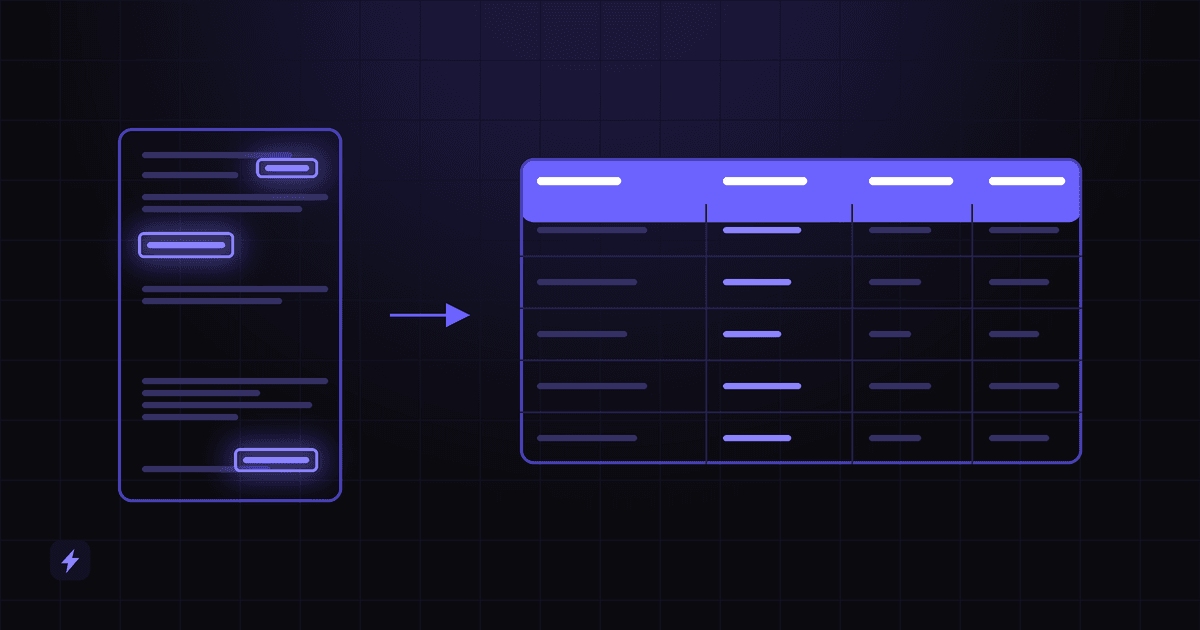
Every business that receives documents makes this decision, usually without noticing. Invoices arrive, forms come back, applications get submitted — and somebody keys the contents into a system. That somebody costs money and time, and there is now a credible alternative. So the question gets asked as a straight fight: is AI document processing better than doing it by hand?
It is the wrong question, and asking it that way is how businesses end up either automating something they should not have or keeping twelve people on work a machine would do better. This article compares the two properly — on cost, speed and accuracy — and is specific about where each one wins. For how the technology actually works underneath, how AI extracts data from documents is the mechanics, and the AI document assistant guide is the wider picture.
The short version
The unit of decision is a workflow, not a company. Automation wins where volume is high and variety is low; people win where the document is unusual, the judgment is real, or the stakes are consequential. Almost every business that gets this right ends up running both — and the number that tells them whether it worked is not accuracy or cost per page, it is what share of documents reach the system with nobody touching them.
"Which is better" is the wrong question
Compare the two as company-wide strategies and you get a stalemate, because both statements are true. Manual processing handles anything you throw at it and needs no configuration. Automated processing handles volume without complaint and never has a Friday afternoon. Neither of those wins the argument.
Change the unit and the answer becomes obvious. Do not ask whether your business should automate document work. Ask, for one specific workflow, two questions: how many of these arrive, and how much do they vary? Those two variables decide it, and they decide it differently for supplier invoices than they do for the twelve bespoke contracts your legal counsel reviews each year.
Most businesses have workflows in three of those four boxes at once. That is why "should we automate document processing" has no answer and "should we automate supplier invoices" usually does.
The comparison, side by side
With the framing settled, the feature-by-feature picture is straightforward — and it is more balanced than either vendors or sceptics usually admit.
Read the table as a whole and the shape of the answer appears. The rows where automation is strong are all about repetition at scale. The rows where people are strong are all about judgment on the unusual. Those are different jobs, and the businesses that do best with document automation are the ones that stop treating them as the same job.
Cost: two different shapes, not two different prices
Cost comparisons in this category almost always go wrong the same way — by comparing a price per page against an hourly rate. That is not the comparison. The two options have different cost shapes, and the shape is what matters over a year.
Manual is nearly all variable cost. Documents multiplied by minutes each, multiplied by a fully loaded hourly rate — not salary, but salary plus employer costs, software, supervision and the space they sit in. It is a straight line: twice the documents, twice the cost, forever. There is no build cost and no configuration, which is exactly why it is the right answer for small volumes.
Automated is mostly fixed cost, with a variable tail that people forget. There is a one-off cost to set the workflow up — connecting the source, mapping the fields, defining the rules, testing it against real documents — and then three ongoing costs: the per-document processing charge, the review time on everything the system flags, and the maintenance when a supplier changes their invoice layout. The middle one is the term that decides business cases, and it is the one left out of most quotes.
The formula worth writing on a whiteboard
Manual cost = documents × minutes each × fully loaded hourly rate. Automated cost = build (once) + documents × processing fee + documents not straight through × minutes to review × the same hourly rate + maintenance. Run both for a year and then for the year after, because the build cost only appears once — the gap between those two answers is your payback period.
The consequence is worth stating plainly, because it cuts both ways. Automation does not make document work free — it converts an ongoing linear cost into a one-off cost plus a much smaller ongoing one. At low volume that trade takes years to repay, and years is long enough that the disruption may not be worth it. At high volume the linear cost is quietly one of the largest line items in the process, and you have been paying it every year.
A hypothetical illustration — every figure below is invented
The numbers in the next table are arbitrary, chosen to be round and to show the shape of the arithmetic. They are not benchmarks, not averages, and not anything Flasin has measured. Substitute your own document count, your own timings and your own hourly cost — the method is the point, and the answer changes completely with the inputs.
Again: those figures are invented. What survives the substitution of your own is the pattern, and it is not that one option is simply cheaper. It is that the same build cost buys a very different payback period at different volumes — roughly three years in the left column, a few months in the right one. A three-year payback is not a no, but it is a different decision from a three-month one. Note too that the review line is large enough in both columns that a business case which omits it is wrong. How to measure AI ROI covers building the baseline these numbers need, which is worth doing before anyone quotes you anything.
Speed: one document versus a thousand
Speed comparisons are usually stated as though one side simply wins. It depends entirely on whether you mean a single document or a queue of them, and conflating the two is why demos impress and rollouts disappoint.
On one document, a person is often faster — and this is the part vendors skip. Someone who knows the form can read an invoice and key six fields in about the time it takes to open the tooling. Automation's advantage does not show up at all at a batch size of one.
On a thousand, it is not close. Volume is where the difference stops being incremental. Microsoft's batch API for Document Intelligence "allows you to bulk process up to 10,000 documents using one request," with the results written to a storage container — one request, ten thousand documents, no queue of people. There is no arrangement of staff that competes with that, and no need for one.
Then there is the clock. Documents do not arrive during office hours. They arrive when your suppliers, customers and applicants send them, which is evenings, weekends and the days your team is short. Manual processing accumulates a backlog during every one of those periods and spends the following morning clearing it. Automated processing does not have a following morning — which for anything where response time is the product, like quotes or applications, is often worth more than the cost saving.
Setup time is real, and it is finite
Automation is slower to start, and it is worth knowing by how much. Microsoft publishes training times for its custom models — 1 to 5 minutes for a template model on consistent layouts, and 30 minutes to 12 hours for a neural model that handles variable ones. That is the model training only; connecting sources, mapping fields, writing rules and testing against real documents is the larger part. A useful way to hold it: the setup is measured in days, the running in minutes, and the payback in months or years depending entirely on your volume.
Accuracy: humans and machines fail differently
This is where the comparison is usually least honest, in both directions. Nobody can tell you in advance whether a system will be more accurate than your team, and any vendor quoting an accuracy figure for your documents before seeing them is quoting a number from someone else's documents.
What can be said — and what actually matters operationally — is that the two fail in different ways.
- Human error is variable and scattered. It rises with fatigue, with queue length, and at the end of a long day. Two people will not make the same mistake on the same document, and the same person may not make it twice. That randomness is unpleasant to manage — you cannot predict it — but it has one great virtue: errors do not correlate, so they do not all land in the same place.
- System error is consistent and correlated. A system that misreads a date format misreads it on every document with that format. If a supplier changes their layout and the field moves, every invoice from that supplier is wrong the same way until somebody notices. The errors are predictable, which makes them findable, but they arrive in blocks rather than scattered.
Consistency is not accuracy
The comparison table above says automation is consistent "when configured correctly." That qualifier is the whole sentence. A well-configured system is reliably right; a badly configured one is reliably wrong, and reliably wrong is worse than occasionally wrong because nobody catches it. Consistency amplifies whatever you have — it does not supply the correctness.
This is also why a confidence score is not a guarantee. Microsoft's own definition is that a confidence score "indicates probability by measuring the degree of statistical certainty that the extracted result is detected correctly" — a probability, not a verdict. How AI extracts data from documents covers how thresholds are set and what to do at each level; the point here is only that a number between 0 and 1 is not the same thing as knowing.
The practical answer is the one both major vendors ship rather than argue about. Alongside confidence thresholds, Amazon's human-review service offers the option to "randomly send a sample of forms to humans for review" even when nothing was flagged, and describes threshold tuning as a way "to achieve the right balance between accuracy and cost-effectiveness" that "can help you implement audits to regularly monitor prediction accuracy." A random audit sample is not a lack of confidence in the system. It is the only way to catch the failure mode where the system is confidently and consistently wrong.
When AI document processing is a good fit
Six signals. The more of them a workflow shows, the more clearly automation is the answer for that workflow.
- Repetitive documents. The same handful of document types, over and over. Microsoft's blank-form test is the sharpest version of this question: "remove all the user-entered data from each form in the set. If the blank forms are identical in appearance, they represent a consistent visual template." If they are, this is the easiest case there is.
- High volume. Enough documents that the linear cost is visible in a budget. If nobody can say roughly how many arrive a month, that is the first thing to find out — the answer usually surprises people upwards.
- Predictable fields. You want the same things every time: supplier, date, reference, total, line items. A defined target list is what makes extraction a solved problem rather than an open one.
- A recurring workflow. The documents arrive on a rhythm and go through the same steps every time. One-off projects rarely repay configuration; Tuesdays do.
- Data re-entry. The tell-tale sign is somebody reading from one screen and typing into another. That is not a document problem, it is a plumbing problem, and it is the most automatable work in most businesses.
- Document classification. Mixed post arriving in one inbox that has to be sorted before anything else happens. Sorting by type is a narrower problem than extraction and often the fastest win available.
The volume of examples needed is smaller than people expect. Microsoft's guidance for training a custom model is that "you only need five examples of the same form or document type to get started" — so the barrier to finding out whether a document type is learnable is a morning, not a quarter. The threshold that actually matters is not how many samples you can gather but how many documents arrive afterwards.
When people should stay in the loop
The strongest statement of this comes from a vendor talking about its own product, which is worth more than the same point made by a sceptic. Microsoft's responsible AI transparency note for Document Intelligence says: "It's important to include a human in the loop for a manual review when you're dealing with high-stakes scenarios (e.g affecting someone's consequential rights) or sensitive data. Machine learning models aren't perfect."
It goes further, and names cases its own service was not built to decide. The product "was not designed or evaluated for the award or denial of benefits," listing medical insurance decisions based on healthcare records and prescriptions, and loan approvals, as scenarios where use "may have unintended consequences." When the company selling the tool draws that line, it is a line worth keeping.
In everyday operational terms, six situations where a person stays in the workflow:
Keep a human in the loop, and include human oversight as a consistent pattern area to explore. This means ensuring constant human oversight of the AI-powered product or feature and to maintain the role of humans in decision-making.
None of this is a limitation to be engineered away in the next model release. It is a design decision about where accountability sits, and businesses that treat it as a temporary technical gap tend to discover the boundary the expensive way. The wider version of this question — what data an AI system should touch at all, and what to ask a vendor about it — is in AI security and privacy for small businesses.
The design that actually wins: both, in sequence
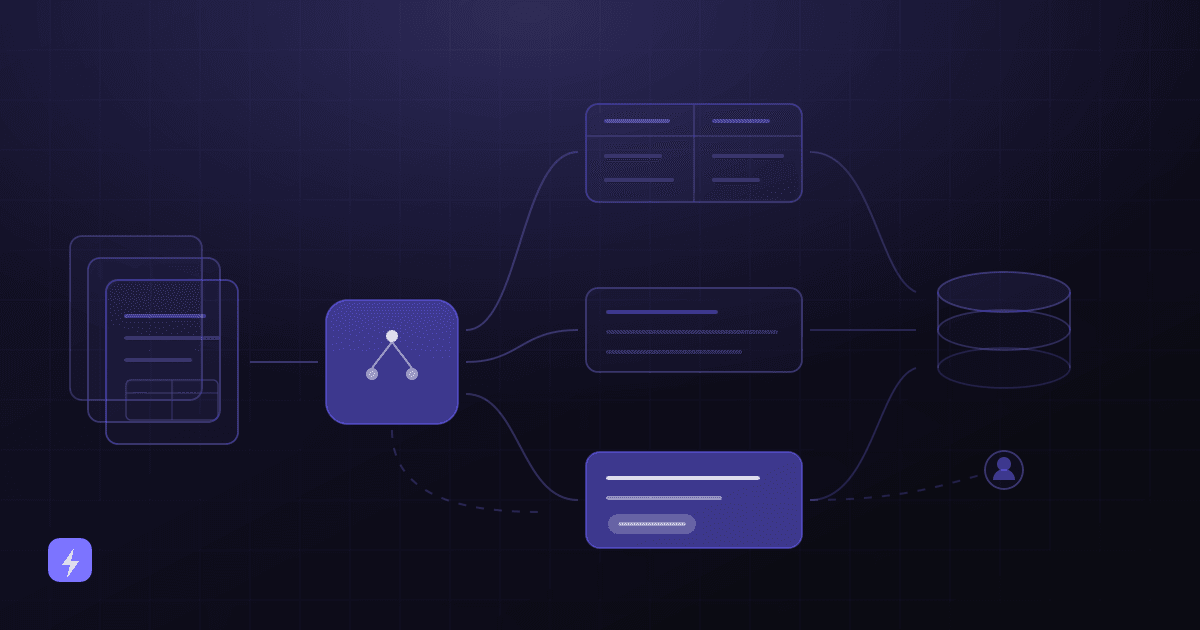
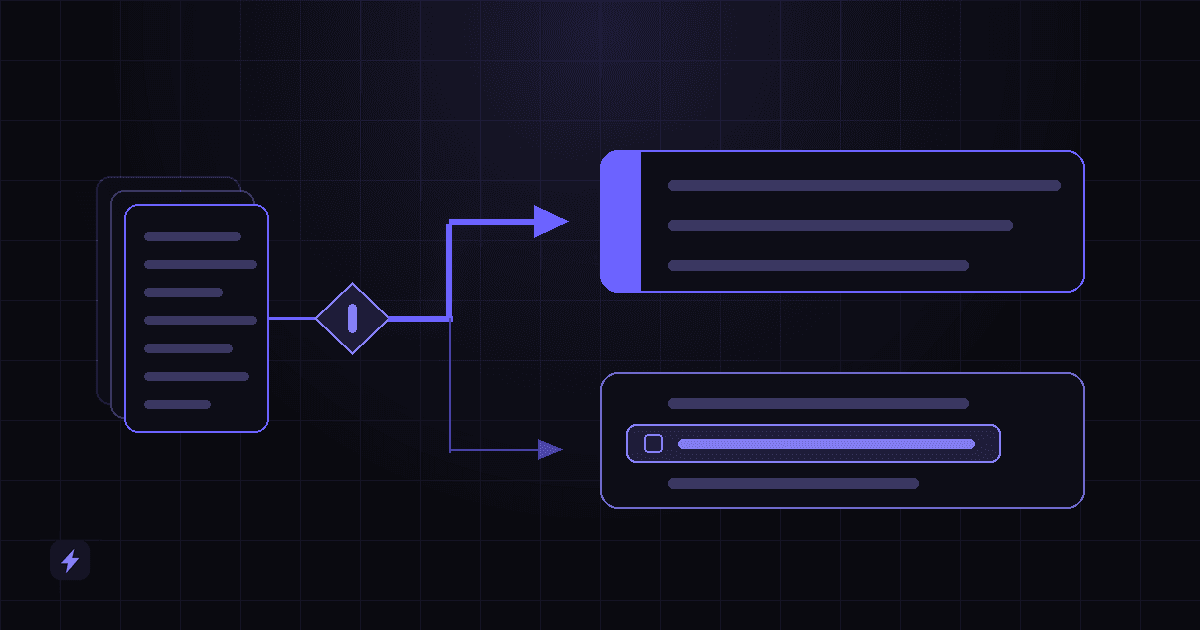
Set out this way, the comparison resolves itself. The two options are not competing for the same work, so the good answer uses each for what it is good at and puts a gate between them.
1. Documents arrive
Email, upload, scanner, shared drive — from wherever they already come from, with nobody asked to change how they send things.
2. Classify
Work out what each one is before trying to read it. Invoice, application, delivery note, contract. Anything unrecognised goes straight to a person rather than being guessed at.
3. Extract the fields
The predictable things, the same way every time. This is the repetitive work the machine is unambiguously better at.
4. Check and gate
Business rules and confidence together decide: does this go through, or does it stop? Totals that do not add up, dates in the wrong range, a field the system was unsure about, an amount over a threshold — all reasons to stop.
5a. Straight through
Everything that passes goes to the system of record with nobody touching it. This is the path that pays for the project.
5b. Human review
Everything that stopped goes to a person, with the document open beside the extracted values so the job is checking rather than re-keying.
6. Audit a sample
A small random share of the straight-through documents gets looked at anyway — the safeguard against being confidently and consistently wrong.
Stage four is where the whole system is really designed, and it is worth being deliberate about because it is the dial between speed and safety. How AI extracts data from documents covers how those thresholds and rules are set, and asking questions across your business documents covers the other thing this pipeline unlocks: once documents are indexed, people can ask them questions instead of hunting through folders.
The positioning worth holding onto
The best document automation system does not remove human oversight. It automates repetitive processing and sends exceptions to people for review — which means the people who used to key in every document now look only at the ones that need a decision. That is a better use of them by any measure, and it is also the design that fails safely.
The one number that tells you whether it worked
Not accuracy. Not cost per page. The number to ask about, quote against, and measure after launch is the straight-through rate: the share of documents that reach the system of record without anybody touching them.
It is the right number because it is the only one that reflects what you were actually buying. Accuracy on the fields the system was confident about tells you very little; a system can be highly accurate on the 30% it will commit to and leave you keying the rest. The straight-through rate is the honest version of the same question.
Two rules for using it. Measure it per document type, because one bad type will hide behind a good average. And never accept a straight-through rate quoted before anyone has seen your documents — the transparency note is direct that customers "should run a pilot or a proof of concept representing their use case to understand the range of confidence values and the extraction quality." The vendor is telling you the number cannot be known in advance. Believe them.
What changes for the people doing it now
This deserves a straight answer rather than a reassuring one, because the team notices either way and the project goes better when nobody is being managed around.
The work changes shape. Keying every document is replaced by handling the ones that stopped — checking flagged extractions, resolving the unusual documents, chasing what is genuinely missing, and owning the rules that decide what gets flagged. It is more skilled and less repetitive, and it is also less predictable: reviewing thirty exceptions takes an attention that keying three hundred invoices does not.
What that means for headcount is a business decision, not a technical one, and any article claiming to know is guessing. What can be said is that the exception queue is real ongoing work, it needs someone who understands the documents, and building the business case as though the whole role disappears is how projects get approved and then quietly disappoint.
Design the review step for people who will actually do it
The most common reason a good extraction system underperforms is that the review queue is unpleasant. If checking a flagged document means opening two systems and comparing them by eye, people will batch it, rush it, and eventually rubber-stamp it — which quietly turns your quality control into a formality. The document and the extracted values belong on one screen, with the uncertain field highlighted.
How to decide, in about an afternoon
You do not need a consultant to get to a defensible answer on your largest document workflow.
Pick one workflow, not the category
Supplier invoices, or new client forms, or delivery notes. One. The company-wide version of this question cannot be answered and the single-workflow version usually can.
Count a month
How many arrived, and how many distinct formats were there? Volume and variety are the two axes from the grid at the top, and half an hour in an inbox usually settles both.
Time it honestly
Sit with whoever does it and time ten documents end to end — including finding the file, the re-entry into the second system, and the interruptions. The real number is almost always larger than the remembered one.
Apply the blank-form test
Strip the entered data from a handful and see whether the blanks look identical. If they do, this is the easy case; if they do not, it is still doable but expect variable-layout handling and a longer setup.
Pilot on your own documents
Not a vendor demo on a vendor's invoices. Your documents, including the awkward ones you were tempted to leave out — those are the ones that decide the straight-through rate.
Decide on the crossover, not the pitch
Your volume, your timings, your hourly cost, and the review time on whatever did not go straight through. If the arithmetic says keep it manual for now, that is a real answer and worth having.
Frequently asked questions
Is AI document processing more accurate than a person?
Nobody can tell you that in advance, and a vendor quoting an accuracy figure for your documents before seeing them is quoting someone else's. What is knowable is that the two fail differently: human errors are scattered and vary with fatigue and workload, while system errors are consistent and repeat identically until someone notices. That is why well-built systems audit a random sample of documents that passed, rather than trusting the confidence score alone.
At what volume does automation start to make sense?
There is no universal number, because it depends on how long each document takes, what an hour of that person's time costs, and how much of the work would still need review. The method is more useful than a threshold: multiply documents by minutes by hourly cost for the manual side, and compare it against the build cost plus per-document processing plus the review time on whatever does not go straight through. Where those lines cross is your answer, and it moves with your inputs.
Will this replace our data entry team?
It changes what they do rather than removing the need for them. Keying every document becomes handling the ones that stopped — flagged extractions, unusual documents, missing information, and ownership of the rules. That is a real ongoing job that needs someone who understands the documents. Whether it changes headcount is a business decision, and any specific claim in either direction would be invented.
What happens when a supplier changes their invoice layout?
That is the characteristic failure mode of automation, and it is worth planning for. Depending on how the system is built, either it adapts, or it starts extracting one field incorrectly on every invoice from that supplier until it is caught. This is exactly what the random audit sample exists to catch, and it is a fair question to ask any vendor: what happens when a layout changes, and how would we find out?
Can we automate part of a workflow rather than all of it?
Yes, and it is usually the better plan. Classification alone — sorting mixed incoming documents by type before anyone touches them — is often the fastest win available and much simpler than full field extraction. Automating the three stable fields and leaving the rest to a person is also a legitimate design, not a failure to finish.
Which document types should we never fully automate?
Anything where the decision affects someone's consequential rights or involves sensitive data. Microsoft's own transparency note for its document service is explicit that it was not designed or evaluated for awarding or denying benefits, naming medical insurance decisions and loan approvals. High-value contracts belong in the same category for a different reason: the cost of one missed clause is not proportional to the number of documents.
Where this leaves you
The honest comparison is not a verdict, it is a boundary. Repetition at scale belongs to the machine, and it is genuinely better at it than any team can be — faster, cheaper past the crossover, and unbothered by a Tuesday with four hundred invoices in it. Judgment on the unusual belongs to people, and no amount of model improvement changes that, because it is a question about accountability rather than capability.
So the practical move is not to choose a side. It is to find the boundary in one workflow, put the automation on one side of it and a review queue on the other, and then watch the straight-through rate to see whether you drew it in the right place. Flasin builds these workflows within the AI document assistant service and alongside business process automation and AI automation, because extracted data is only worth something once it reaches a system and triggers the next step. If you want the mechanics first, how AI extracts data from documents is the detail, and the AI glossary defines the vocabulary a vendor will use at you.
Sources
Every quotation above was read from the publisher's own documentation on 5 September 2026 and is attributed where it appears, not only here. The human-oversight guidance, the named out-of-scope uses and the pilot recommendation come from Microsoft Learn's responsible AI transparency note for Document Intelligence; the batch limit, the five-sample training floor, the blank-form template test and the model training times from Microsoft Learn's Document Intelligence documentation; the confidence-score definition from its accuracy and confidence guidance; and the random audit sample and threshold tuning from AWS documentation for Amazon A2I with Amazon Textract.
There are no accuracy rates, error rates, time-saved figures, cost savings or prices in this article for either option, because none could be verified for the claims being made — including for manual data entry, where the widely repeated error-rate figures trace back to each other rather than to a source. The worked example is labelled hypothetical and every figure in it is invented. The only real numbers are Microsoft's published product limits, quoted as limits rather than as results.